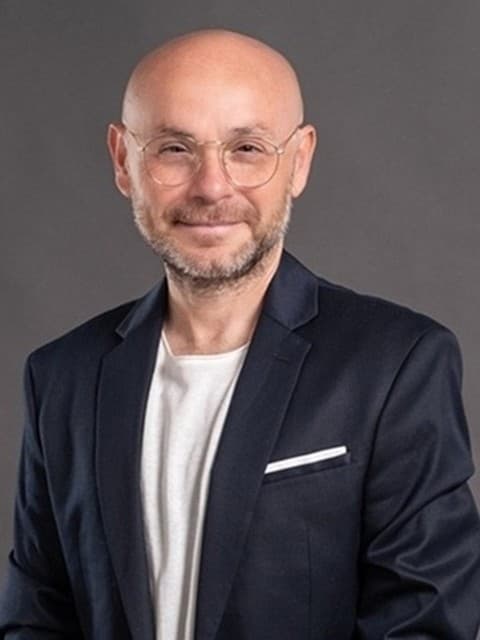
Ali is a Professor of International Relations and Middle East Politics at Loughborough University and served as the 2017-19 Prince Claus Chair (PCC) in Development and Equity at the International Institute of Social Studies of the Erasmus University in Rotterdam. As PCC, Ali worked under the theme of 'Migration and Human Security. He is a member of the ESRC Peer Review College.
Ali has a PhD in International Politics from Aberystwyth University (UK), and MA in European Politics from Lund University (Sweden). Prior to Loughborough, he was Associate Professor at Bilkent University (Turkey), Department of International Relations (until 2016). He served as a member of Executive Committee, Feminist Theory and Gender Studies Section of International Studies Association (2016-2018). He was the co-convener of British International Studies Association Gendering International Relations Working Group (2019-2021). In addition, he was Associate Editor of International Relations, and member of Editorial Board of Mediterranean Politics.
He was a post-doctoral researcher in FP7 funded INEX Project entitled ‘Converging and Conflicting Ethical Values in the Internal/External Security Continuum in Europe funded by European Commission 7th Framework Programme) at Bilkent University, Ankara, and conducted research in the area of European relations with the Middle Eastern states. Ali was a co-investigator in the project “Exploring Civil Society Strategies for Democratic Renewal” funded by United Kingdom Economic and Social Research Council (ESRC), (February 2016-February 2018). In this project, he studied how declining trust in governance led to popular uprisings in the Middle East, in particular, Turkey. He was also associate researcher in the British Academy-funded project entitled “Alliances and Trust-building in International Politics” (September 2014-September 2016). His role was to understand why trust between states can fail in international alliances and how it can be restored.
Ali was a co-investigator in the project entitled “FAKENEWS: Impacts on Societal trust and Resilience”, led by the Arctic University in Tromso and funded by the Norwegian Research Council (2021-2025). Additionally, he conducted research in the project run by the Diocese of Leicester entitled ‘BAME Intercultural Worshipping Communities’ (2019-2024) funded by the Church of England Strategic Development Fund. In this project, he collects data and conducts analyses on BAME representation in and inclusion to worshipping communities in Leicestershire. Ali is actively involved with dissemination of knowledge practices. He frequently writes for the Conversation on the matters of international security. He conducts regular consultancy work.
His interdisciplinary research combines security studies, international relations theory, political sociology and psychology, feminist, queer, and postcolonial thought, cultural studies and affect studies. His distinctive research agenda examines how socio-psychological dynamics shape global politics of security, organise relations of power and constitute political identities in relation to issues including migration, the rise of the Global South, global (dis)order, and power hierarchies in global politics.
Ali is currently conducting research on the interaction between emotions, sexuality and statecraft in the Middle East.
Ali is the author of 'Rethinking Security in the Age of Migration: Trust and Emancipation in Europe' (Routledge, 2013 and 2018, 2nd edition) and 'Turkey, Power and the West: Gendered International Relations and Foreign Policy' (IB Tauris, 2016). His third book Positive Security (co-authored with Prof Gunhild Hoogensen Gjorv) was published in 2022 by Routledge. He is currently drafting his fourth book for Routledge Security Studies series.
Ali teaches the undergraduate module “International Politics of the Middle East” and postgraduate module “Security Challenges in the Global South”.
The teaching philosophy he adopts is based on interactive learning and active student participation, namely cooperative teaching and ‘students as co-producers’. Ali believes that the time of lecturers as ‘sage on the stage’ or even ‘guide on the side’ has now passed; the new academia and labour market demand student–teacher collaboration in producing knowledge and improving students’ academic and transferrable skills.
The practices of lecturing, explaining and clarifying concepts, and providing real-world examples are vital components of Ali's role as a lecturer. His aim as lecturer is to encourage the construction of well-structured, cohesive, and logically sound arguments. The most useful way to achieve this objective is by utilising case studies from world politics to explain scientific concepts. Emergent learning outcomes include not simply an intellectual understanding of global issues, but also an insightful grasp of the challenging conceptual discussions of the discipline.
Samples of student feedback from Loughborough University:
I didn't expect to enjoy the module as much as I did; the quality of Ali's lecturing and organisation is like no other lecturer I have come across before. The module handbook was exceptionally detailed and informative.
Ali genuinely listens to student feedback and acts on it.
Taught me a lot, very interesting, also taught me about other skills outside the module and advice.
This module offered the opportunity to actively engage with one another during the Crisis Game, using what we have been taught in lectures - which is something that has not been offered during the course so far.
Ali supervises PhD projects in the areas of security studies -broadly defined, Middle East politics, and sociology and psychology of international relations. If you are interested in working with him, please get in touch.
Examples of Recent Postgraduate Research Students
- Judy Furtonova-Russell, ‘The Climate Change-Induced Migration’
- Klara Vloric: "Migration of Yugoslav Muslims to Turkey between the Two World Wars"
- Seyma Bicer Hazir: "Memory, Trauma, and the Nagarno-Karabag Conflict"
- Junqi Ren: "International Norms and ASEAN"
- Caglar Ozturk, ‘Turkey's EU membership 2002-2019: at crossroads between transformational leadership, domestic politics and international dynamics’
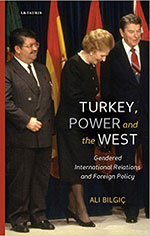
Turkey, Power and the West: Gendered International Relations and Foreign Policy
Publisher: I.B.Tauris (30 July 2016)
Author: Ali Bilgic
During the leadership of Recep Tayyip Erdodan and the AKP, the Turkish government shifted from a 'reactive' to an 'activist' foreign policy. As a result, many in the West increasingly began to see Turkey as a key actor in the international relations of the region, and indeed the wider international stage.
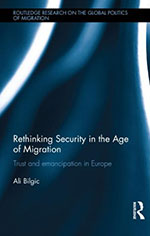
Rethinking Security in the Age of Migration
Publisher: 2013 by Routledge
Author: Ali Bilgic
Migration and especially irregular migration are politically sensitive and highly debated issues in the developed world, particularly in Europe. This book analyses irregular protection-seeking migration in Europe, with close attention to sub-Saharan migration into the EU, from the perspective of emancipatory security theory.
Books
- Positive Security: Collective Life in an Uncertain World (co-authored Gunhild G.Hoogensen), London: Routledge, 2022
- Turkey, Power and the West: Gendered International Relations and Foreign Policy, London: I.B. Tauris, 2016.
- Rethinking Security in the Age of Migration (2018, 2nd edition): Trust and Emancipation in Europe, London: Routledge, 2013.
Selected Journal Articles
- (2026) Ontological (In)Security After Truth: Disinformation as an Affective Technology, Cooperation and Conflict
- (2025) Queering Ontological (In)Security: A Psychoanalysis of Political Homophobia, Critical Studies on Security, Critical Studies on Security, Vol.13 no: 3, 367-382.
- (2023) Becoming a Humanitarian State: A performative analysis of ‘status-seeking’ as statecraft in world politics, Review of International Studies, Vol.50 no: 4, 700-719.
- (2022) “Desires, Fantasies, and Hierarchies: Postcolonial Status Anxiety through Ontological Security”, Alternatives, Special Issue Governing and Navigating Subjects in the Age of 'Permanent Anxieties': National, Regional, and Global Perspectives (with Jordan Pilcher).
- (2022) “Turkey’s Antarctic Quest: Historical Legacies, Geopolitical Ambitions”, RUSI Journal, Vol. 166 no: 6-7, 64-72.
- (2021) “Who is entitled to feel in the age of populism?: Women’s Resistance to Migrant Detention in Britain”, International Affairs, Vol. 97 no: 2, 483-502. (with Athina Gkouti) (Included in the Chatham House Reflections at 100 series)